









NewsBusiness & Economy
Are Amazon, Walmart, and eBay’s Online ‘Marketplaces’ Providing a Refuge For Goods Made With Forced Labor?
31.01.2019
The Committee on the Application of Standards of the International Labor Organization (ILO) sharply criticized Turkmenistan over the continued use of forced labor during the cotton harvest. The Committee found that despite ratifying Convention No. 105 on the Abolition of Forced Labor and cooperating with the ILO, the country continues to use coerced labor from public-sector employees during the cotton harvest. It requested that the government provide detailed information by September 1 on specific measures taken and concrete results achieved, both in legislation and in practice.
Turkmenistan’s Position
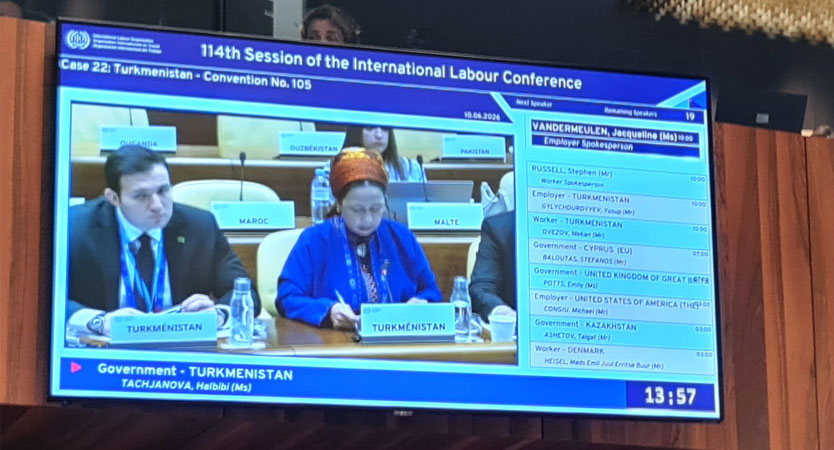
The 114th annual International Labor Conference was held in Geneva from June 1 to 12. As part of the conference, the ILO Committee on the Application of Standards met and reviewed Turkmenistan’s implementation of Convention No. 105 on the Abolition of Forced Labor for the fifth time. The country ratified the convention in 1997. The case concerns the forced mobilization of public-sector employees for cotton picking.
The Committee heard the position of the government representative. Turkmenistan’s delegation was led by Deputy Minister of Labor and Social Protection Halbibi Tachjanova (pictured). She expressed Turkmenistan’s commitment to the convention and its readiness to cooperate with the ILO. She also highlighted progress already achieved by the country.
Tachjanova said amendments had been introduced to the Labor Code that fully prohibit child labor and forced labor. She referred to plans for comprehensive legislative changes through 2030. A draft presidential decree is currently being prepared that would directly prohibit the use of any form of forced labor in cotton harvesting.
The Turkmen representative also spoke about the development of the state labor inspection system. According to her, state inspectors carried out 3,867 inspections in 2025 and identified violations in 2,352 cases, resulting in 3,040 administrative sanctions. She noted ongoing wage reforms that, according to the government, doubled pay levels in the sector during 2023-24, as well as other measures.
Separate delegates spoke on behalf of employers and workers in Turkmenistan.
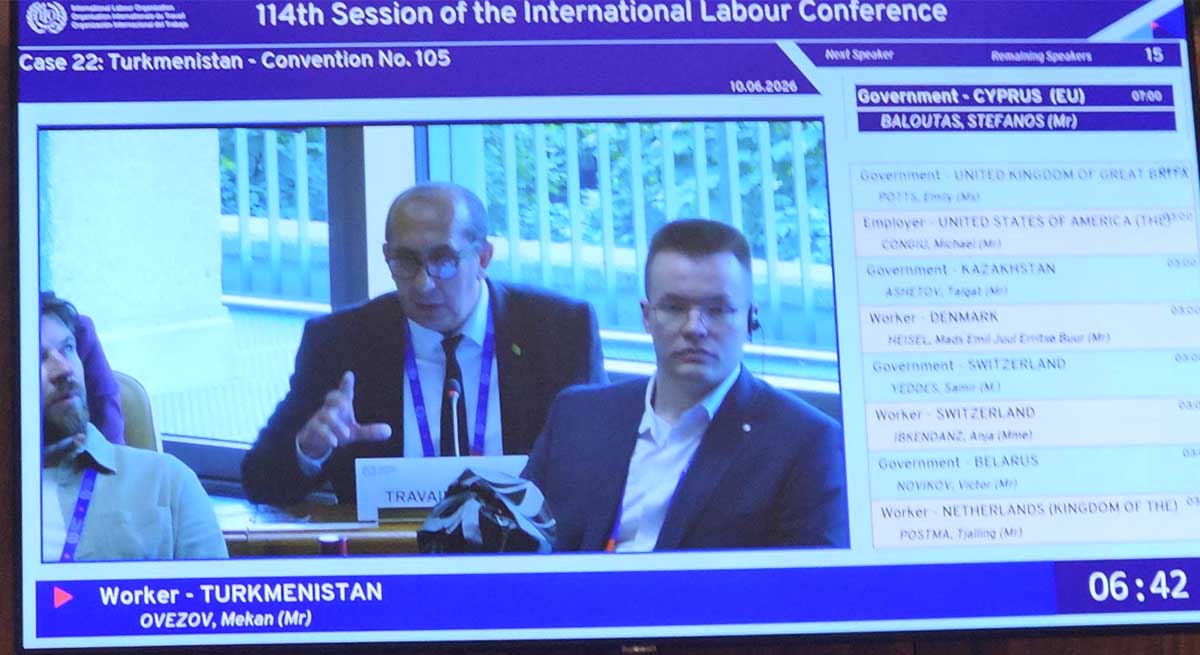
Yusup Gylychdurdyyev, one of the leaders of the country’s Union of Industrialists and Entrepreneurs, represented employers. He listed measures encouraging private-sector participation in the agro-industrial sector and said that the 340 farmers’ associations currently operating in Turkmenistan are gradually being transferred to private management. According to him, private operators do not possess the administrative means to compel cotton pickers, and such practices are incompatible with their business model.
Mekan Ovezov (pictured) of the National Trade Union Center represented workers. He spoke about cooperation between trade unions, the government, employers and the ILO, as well as efforts to strengthen the skills of union members and other workers. His remarks did not include examples of Turkmen trade unions defending workers’ rights.
Criticism From Observers
Other participants also addressed the Committee.
Speaking on behalf of the employers’ members of the Committee, Canadian lawyer Jackie Vandermuelen noted that the Committee was reviewing Turkmenistan’s case for the fifth time and that ILO experts had raised concerns on nine occasions, demonstrating the persistent nature of the forced labor problem in the country’s cotton sector. Vandermuelen acknowledged some progress in recent years but expressed deep concern about the findings of the ILO’s 2025 monitoring. Regression on key indicators related to forced labor and interference with the monitoring process pointed to the need for additional efforts to ensure that legal and policy reforms produce concrete results in practice, she said.
The workers’ members of the Committee were represented by Stephen Russell, an expert on international labor standards from the British Trades Union Congress. He expressed even greater concern and cited examples from ILO and Cotton Campaign reports. The expert pointed out that civil society in the country cannot freely participate in monitoring and that workers’ rights to establish independent trade unions are being violated.
Speaking on behalf of the International Union of Food, Agricultural, Hotel, Restaurant, Catering, Tobacco and Allied Workers’ Associations (IUF), Education International and the Cotton Campaign was Ruslan Myatiev, editor of Turkmen.news.
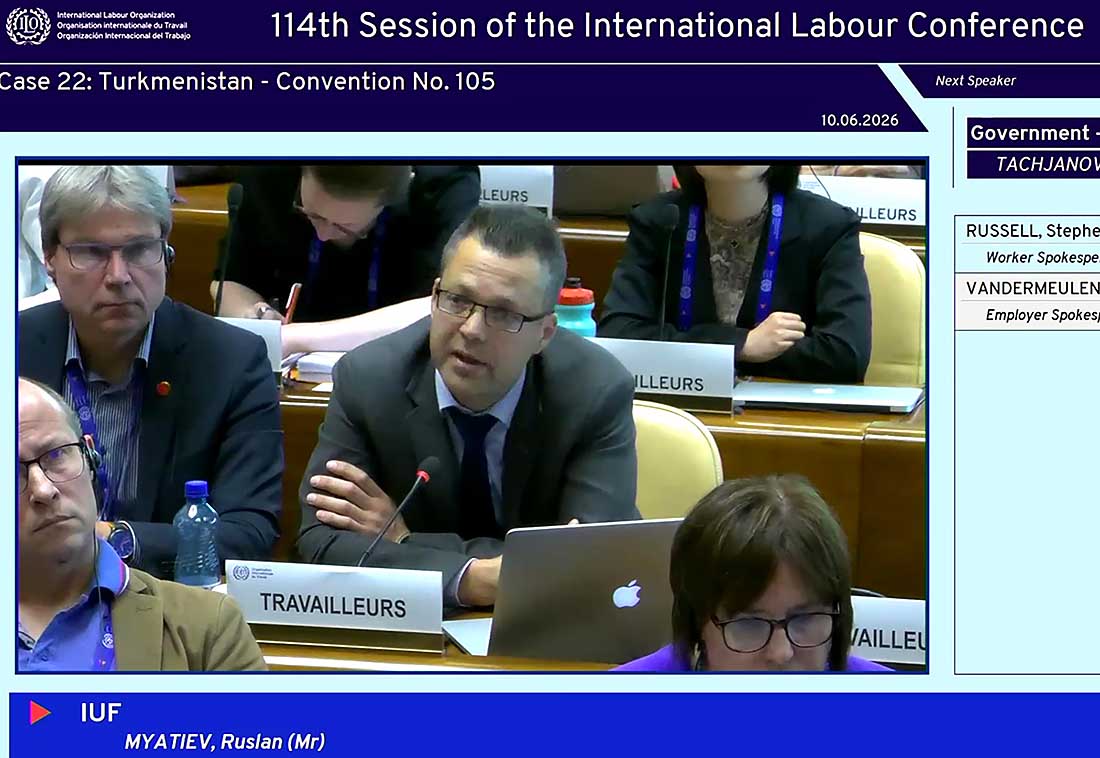
“The Government reports the preparation of a draft Presidential decree on organizing the cotton harvest in 2026. To meaningfully address State-imposed forced labor, such unequivocal decree must make it clear that the use of forced labor in the harvest or money extortion are prohibited. Political statement is already envisaged in the road map that the Government signed with the ILO, but this commitment remains unimplemented,” he said.
Myatiev also said that effective implementation of the Roadmap requires a complaints mechanism, protection against retaliation for people reporting coercion, and sanctions against officials responsible for forced mobilization. The government has not implemented any of these measures, he said.
Finally, Myatiev said that trade unions in Turkmenistan do not protect workers from forced labor. On the contrary, they are often involved in the system by collecting money from workers or compiling lists of people to be sent to the cotton fields. The government should take urgent steps to implement reforms addressing the causes of forced labor and strengthening fundamental rights, particularly freedom of assembly, freedom of expression and collective bargaining rights.
Eleven additional delegates from various countries also addressed the session.
Committee Conclusions
After hearing the speakers and examining the findings of the ILO report, the Committee noted certain progress by Turkmenistan in efforts to eradicate forced labor. Nevertheless, it found that the problem remains widespread during the harvesting of cotton produced under the state order system.
Taking into account the discussion, the Committee urged the Government, in consultation and cooperation with the social partners, to take all necessary measures to:
The Committee urged the Turkmen government to accept ILO technical assistance and requested that it provide detailed information by September 1 on specific measures taken and concrete results achieved, both in legislation and in practice.
At the end of the session, Deputy Labor Minister Halbibi Tachjanova again took the floor. She said some of the recommendations are already included in the Roadmap and will remain priorities for Turkmenistan. Among those measures, she mentioned a mechanism for filing complaints regarding labor violations. The deputy minister said that achieving long-term and sustainable results requires time.
31.01.2019
23.03.2021
06.10.2020
Turkmenistan Mobilizes Civil Servants to Pick Cotton; Farmers Underpaid for Their Harvest
15.10.2026

Foreign Singers Perform at Private Wedding After Concert in Ashgabat
14.10.2026
New Pretrial Detention Center Built in Dashoguz Province
14.10.2026
Leaked Warrant List Reveals How Turkmenistan Targets Critics Abroad
01.10.2026
Turkmenistan Halves Fuel Allowance For Travelers Leaving Country, Raises Fee For Each Extra Liter
11.08.2026
Tell us!






Add comment
your e-mail will not be published