









NewsSPOTLIGHT
Grounded. How Corrupt Officials Monopolize Turkmenistan’s Aviation Sector
03.12.2024
Turkmenistan, an oil-producing country, has been facing severe fuel shortages for several years. Long lines regularly form at gas stations. While the problem is less noticeable in Ashgabat, shortages of gasoline and diesel in the regions and remote districts have become so acute that residents have sent telegrams directly to the president. But the country, which produces and refines its own oil, is also running short of jet fuel. By late 2024, the situation had become so critical that it nearly forced the suspension of civil aviation flights.
“We would like to inform you that, as of June 3, Ashgabat International Airport has 2,500 metric tons of TS-1 aviation kerosene remaining. With average daily consumption of 700 metric tons, current supplies will last for only two to three days.”
These are excerpts from a 2024 letter sent by Murat Suhanberdiev, director-general of Ashgabat International Airport, to the state concern Turkmennebit. In the letter, the official says the petroleum products depot in Anew has failed to supply the airport with aviation fuel on time, warning that the shortage could affect flight safety and disrupt flight schedules.
Apparently, a way was found to overcome that critical situation, as flights were not suspended. But the underlying fuel supply problem was never resolved, and the situation repeated itself six months later.
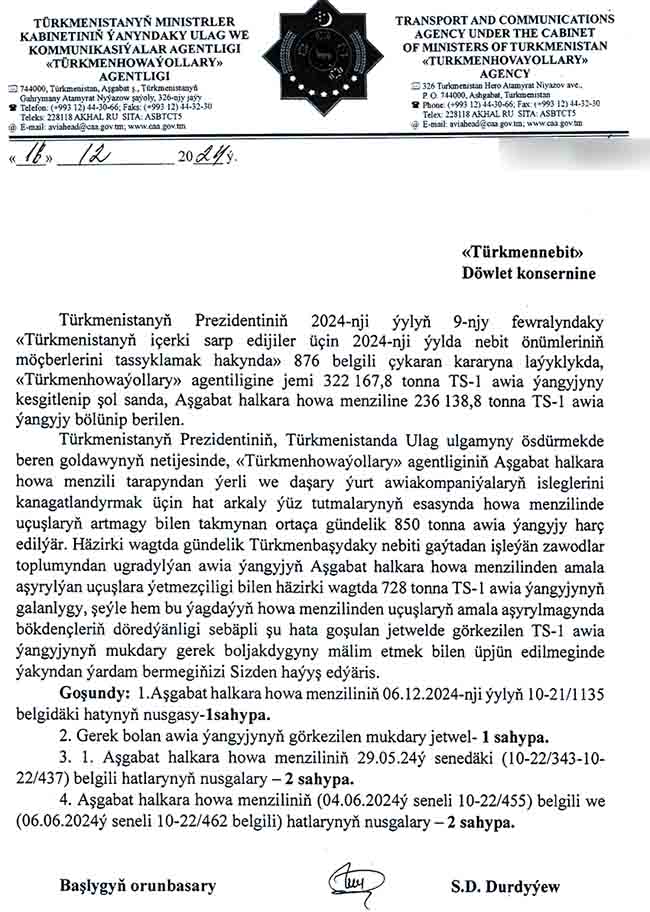
On December 16, Suleyman Durdyyev, deputy head of the Turkmenhowayollary Agency, wrote to the management of Turkmennebit (see copy of his letter).
He said that, because of an increase in flights and growing demand for aviation kerosene from domestic and international airlines serving Ashgabat, average daily fuel consumption had risen to 850 metric tons. At the time the letter was written, the capital’s airport had only 728 metric tons of kerosene remaining — enough for less than one day.
What exactly is causing the fuel shortages at the airport remains unclear, but according to turkmen.news sources, the problem persists to this day. It is only temporarily resolved through lengthy exchanges of official letters, and only after the situation reaches a critical point.
In June 2026, Durdyyev again wrote to Turkmennebit, as well as to the Main Directorate of Turkmennebitonumleri, which operates within the state concern, requesting that the July kerosene allocation for Turkmenbashi Airport be redirected to Ashgabat International Airport, while fuel intended for Mary Airport be reassigned to Dashoguz Airport.
No response to the request has been received so far.
A turkmen.news source within the State Service Turkmenhowayollary — the name adopted for the agency in 2025 — said the country’s aviation authorities have grown tired of managing kerosene supplies on an ad hoc basis.
“The key problem is that both the aviation and oil industries are heavily regulated by the state,” the source said. “Production plans, fuel allocation quotas and prices are all approved a year in advance and at the presidential level. On top of that, kerosene is transported by rail to its final destination under an annual plan also approved by the president. Any disruption in this complex chain pushes the situation to the breaking point. At the same time, officials are afraid to take responsibility or suggest that the head of state adjust any part of the system.”
In Turkmenistan, oil production, refining and distribution are controlled by the state. In 2025, the authorities reported refining 4.96 million metric tons of crude oil, including the production of 434,000 metric tons of aviation kerosene. Officials said that output was 5.4% higher than the previous year, meaning that 411,765 metric tons of kerosene were produced in 2024.
Each year, the president of Turkmenistan issues a decree specifying how these volumes will be allocated between domestic consumers and export markets. The exact quotas are not made public. However, according to Durdyyev’s letter, Ashgabat airport’s annual demand that year amounted to 310,250 metric tons (850 metric tons per day multiplied by 365 days). The country also has six other airports: Turkmenbashi, Balkanabat, Kerki, Turkmenabat, Mary and Dashoguz. Other domestic consumers include the Defense Ministry, the Interior Ministry and the State Border Service.
How much kerosene is allocated to meet their needs? According to information obtained by turkmen.news, 320,000 metric tons of kerosene were allocated to domestic consumers for 2026. Of that amount, 298,000 metric tons were earmarked for the country’s airports, while 21,700 metric tons were placed in the strategic reserve of the Turkmenhowayollary State Service. But 298,000 metric tons would not have been enough even by the standards of two years earlier — or even for Ashgabat airport alone. Since then, the total number of domestic and international flights has only increased.
At the same time, Turkmenistan also exports jet fuel, which is far more profitable than selling it on the domestic market at heavily subsidized prices. The state receives just 27.74 manat (less than $1.50) per metric ton of fuel sold to Turkmenhowayollary. By comparison, the current global market price for TS-1 jet fuel is about $930 per metric ton. The total volume of Turkmenistan’s aviation fuel exports is not publicly disclosed, but judging by reports on individual contracts and export destinations, it amounts to at least several tens of thousands of metric tons a year.
In effect, Turkmenistan is trying to combine rigid state planning at home with market-based fuel exports abroad. It is the domestic part of that system that is failing. Even the basic math does not add up, and that is before accounting for unforeseen circumstances, such as unplanned foreign trips by Gurbanguly Berdimuhamedov and his daughter, Oguljahan Atabayeva.
Father and daughter travel on separate aircraft. During Berdimuhamedov’s most recent trip to the United States, his plane developed a mechanical problem, prompting authorities to dispatch another government aircraft from Ashgabat. The strategic fuel reserve maintained for such situations is clearly insufficient. There are also losses from falsified reporting and fuel theft — problems that are well known to the country’s senior leadership but remain unresolved and are not reflected in official planning.
Most importantly, the system leaves no room for growth. New direct flights to Uzbekistan and other anticipated destinations, as well as efforts to make Turkmenistan’s costly international airports economically viable, are unlikely to succeed as long as the priority remains maintaining the appearance of stability in official reporting rather than pursuing genuine development.
***
In August 2025, Polat Berdiyev, a resident of the settlement of Etrek in Balkan Province — the birthplace of Turkmenistan’s oil industry — sent a telegram to President Serdar Berdimuhamedov. In it, he complained that shortages of AI-95 gasoline at filling stations were creating difficulties for local residents and asked the president to help resolve the problem.
According to turkmen.news sources, however, the shortages continue to this day, not only in Balkan Province but in other regions of Turkmenistan as well.
03.12.2024

30.01.2025

13.04.2026

Bone Tuberculosis Worsens in Detention for Human Rights Defender Mansur Mingelov
15.10.2026
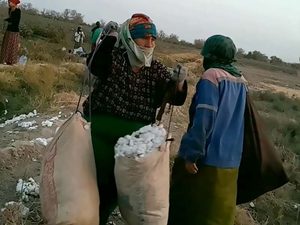
Turkmenistan Mobilizes Civil Servants to Pick Cotton; Farmers Underpaid for Their Harvest
15.10.2026

Foreign Singers Perform at Private Wedding After Concert in Ashgabat
14.10.2026
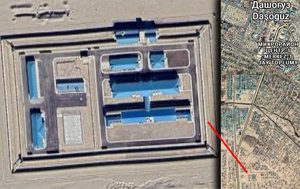
New Pretrial Detention Center Built in Dashoguz Province
14.10.2026

Leaked Warrant List Reveals How Turkmenistan Targets Critics Abroad
01.10.2026
Tell us!







Add comment
your e-mail will not be published