Turkmenistan’s 2026 cotton-picking campaign began on September 9, but turkmen.news observers have already documented widespread labor violations in every region. In Ahal, Dashoguz, Lebap and Mary provinces, civil servants are being sent to the fields and forced to pay for replacement pickers. Some of the pickers are children. Here are the key facts as of end September.
Government Involvement
The forced cotton picking is not merely taking place with the Turkmen government’s knowledge; it is organized by the government itself. The system is fully centralized. Observers in Lebap province have described in detail how it works.
In every district, so-called headquarters meetings are held twice a week, bringing together district mayors with local heads of public institutions. At these meetings, mayors assign cotton delivery targets to the heads of institutions and check whether they are being met.
Meanwhile, in sectoral public agencies, each official oversees cotton picking at several institutions under their supervision. For example, in a district education department, every employee from specialist to deputy director oversees five or six schools. The local mayor, in turn, receives figures from archins (village heads) showing how many people each school or kindergarten has sent to the fields and how much cotton they have picked.
Those who fall behind are publicly and harshly reprimanded. The official deemed responsible then publicly expresses remorse and promises to do better.
Heads of public institutions try to create the impression that no one is being forced to take part in the harvest. To do so, they prepare a collective statement each time, purportedly on behalf of the employees scheduled to go cotton picking that week. Every statement has the same heading and wording: “We, the undersigned, voluntarily travel to the cotton fields in order to help fill the state granaries with white gold.” Only the date and employees’ names change. These documents are presented to staff for signature by human resources department heads or even trade union committees at schools, kindergartens, hospitals and other state institutions.
Lebap Province
The mobilization of workers and collection of money have been actively underway since August 13. The so-called headquarters meetings are held by the governor of Lebap province and district mayors and their deputies.
In Dovletli district, the meetings are held by Mayor Novruz Allakuliyev. He summons the heads of all local public institutions except law enforcement on Wednesdays or Fridays at 9 p.m. The meetings end around midnight or 1 a.m. The mayor has set a quota of 50 kilograms per person, which everyone must meet. For example, if an organization sends 40 people to pick cotton in a day, it must deliver at least 2 metric tons. If the figures submitted by the archin show 1.9 metric tons, Allakuliyev berates the official overseeing the organization in the harshest terms.
The same practice was in place last year in Hojambaz district under Mayor Erkin Achylov. He now heads the administration of Turkmenabat.
Employees of state organizations in Turkmenabat and Seydi, as well as in Farap, Danew, Charjew, Darganata, Koytendag, Kerki and Hojambaz districts, are being forced to work without exception. In the authorities’ eyes, old age, chronic illnesses and recent surgeries are not valid reasons to excuse anyone from fieldwork. The only way to avoid it is to pay for a hired picker.
Rates vary from place to place, with no fixed amount or payment schedule. Workers pay either daily or in advance for a week, 10 days or even a month. Payments start at 20 manats for one hired picker’s trip to the fields. This is what technical and low-paid employees pay when their health or other circumstances prevent them from going to the fields themselves. In most cases, however, workers are required to pick cotton themselves. Schools keep just one cleaner on duty for the entire cotton-picking season; security guards work only their scheduled shifts and go to the fields on other days. Kindergarten attendants look after several groups, while hospital orderlies cover additional departments.
At some institutions, including banks, higher-paid employees are asked to pay 70 manats. They are not allowed to go to the fields themselves. Employees must make these payments three times a week.
The Koytendag district education department requires teachers to pay 200 manats every 10 days.
In Turkmenabat, the pickup and hiring point is located at the traffic circle near the Railway Hospital. People seeking work gather there and offer the prices at which they are willing to pick cotton. Representatives of public organizations responsible for cotton picking hire them.
Employees of the Lebap provincial branch of Turkmenawtoyollary, the state road agency, pay 200 manats a month — about $10 at the market exchange rate. This is a substantial share of their monthly salaries, which amount to just 1,000 to 1,200 manats. In reality, they take home even less: drivers, for example, regularly pay out of pocket for spare parts, engine oil and other supplies. Their job requires specialized skills. The number of drivers is dwindling as more quit and leave the country to work abroad.
In Turkmenabat schools, employees are charged 30 manats nine or 10 times a month, amounting to 270 to 300 manats monthly. In August, some schools did not collect money from retired employees who were still working. Starting in September, everyone must pay.
District schools face a shortage of principals. One major reason is that people do not want to take part in the cotton harvest. Education department officials overseeing the schools require principals to personally monitor picking and take responsibility for falling behind schedule. Those officials, in turn, receive these orders from district mayors during the headquarters meetings. In 2024, the principal of a school in the village of Burguchi in Koytendag district was killed in a car crash while returning home from one such meeting.
District schools also have a noticeable shortage of full-time teachers. Only 10% to 15% work full time; most are employed at 0.7 or even 0.5 full-time equivalent. Nevertheless, everyone is charged the same amount, starting at 20 manats a day.
Teachers who refuse to pick cotton or pay for it face disciplinary action. Officials go to great lengths to conceal the fact that the punishments are related to cotton picking. Education department specialists — the same officials assigned to oversee the schools — begin attending these teachers’ classes, looking for violations they can document. The teacher then receives a reprimand. Officials do not stop there: They look for another violation and issue a severe reprimand, followed by dismissal. The process is halted if the “offending” teacher pays off their cotton-picking debts and offers an additional bribe to “make amends.”
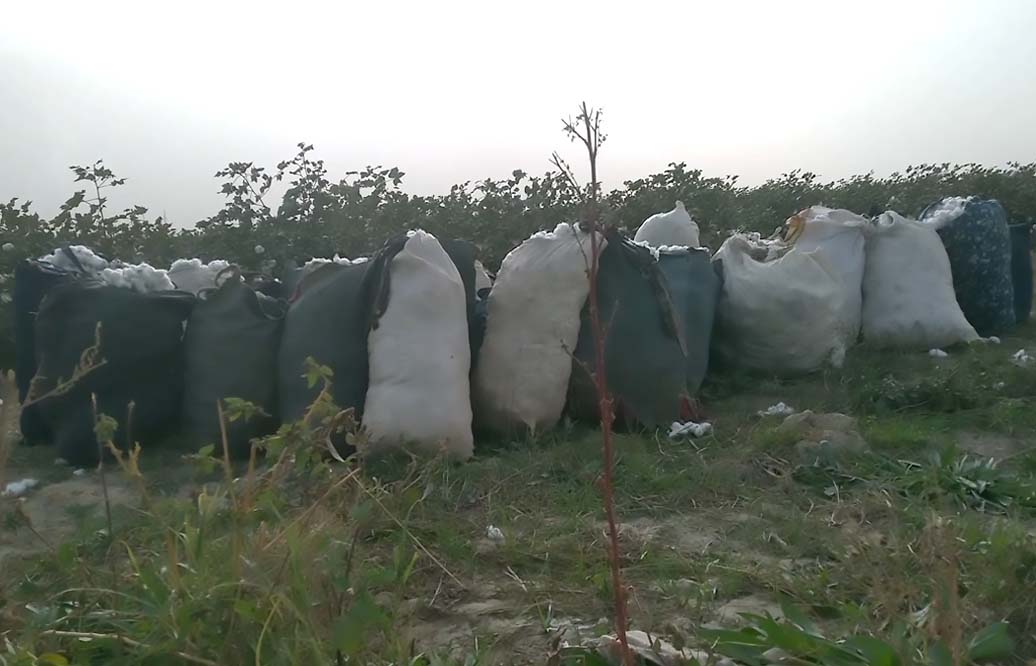
Bags with cotton picked by civil servants
Dashoguz Province
Meetings with civil servants about the start of cotton picking began on September 5.
Employees of the Dashoguz oil depot are required to pay 380 manats a month despite monthly salaries of 2,200 manats. The collection is handled by a department head named Eziz.
Teachers and other school employees in Dashoguz pay 70 manats a week in two installments. Work schedules have already been drawn up for them, with groups of 20. Initially, they are taken to Shabat district, the closest district to the city. But officials warned at meetings that once the harvest reaches full swing, the weekly payments will rise to 80 manats and workers will be taken to more distant Koneurgench and Ruhubelent districts to pick cotton.
Most teachers pay for hired pickers because they cannot leave their classes unattended: there is no one to take over.
Ahal Province
Employees at one state institution in Ahal province are required to pay 200 manats a month. To protect the sources, turkmen.news is not identifying the institution, its sector or the district where it is located, but all details will be provided to representatives of the International Labor Organization. ILO monitors visited this very institution in 2025. Before their arrival, a member of the management team gathered employees and instructed them not to say anything about either forced labor or the collection of money. As a result, most employees gave the answers the administration wanted, while others remained silent or refused to fill out questionnaires. This is the second known case of officials openly interfering with the work of ILO monitors. In 2024, a group of employees at a medical institution in Mary province were prevented from meeting foreign visitors who had come to conduct a survey. The workers were held for several hours and allowed to return to work only after the ILO representatives had left.
Mary Province
Farmers have already begun facing violations by officials. When they deliver their harvested cotton to a procurement center, the recorded weight is reduced by 22% on the grounds that the cotton is wet. Farmers are protesting en masse, saying that moisture content cannot exceed 5.5% in 40-degree heat. Buyers measure moisture on the spot by taking a cotton sample from the batch, placing it in a special container and inserting a device with a metal probe. Farmers believe the device has been preset to produce inaccurate readings. Disputes between farmers and state procurement agents sometimes escalate into fights, which police are called in to break up.
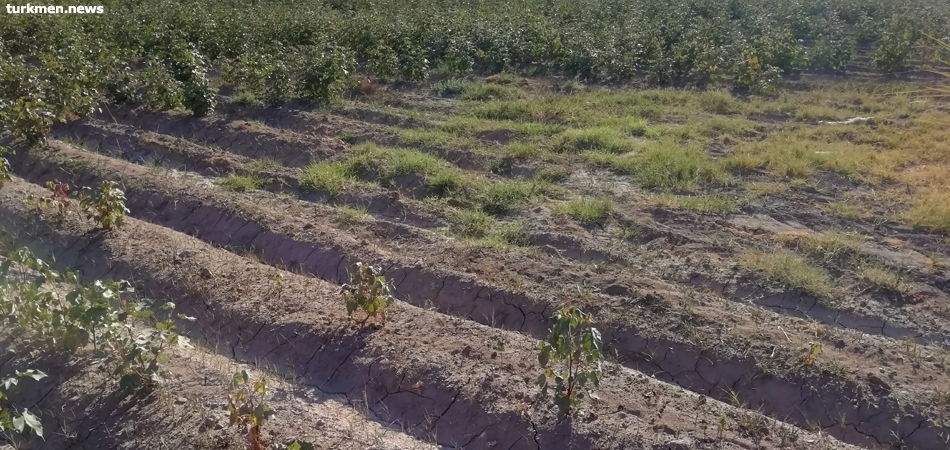
According to farmers from different parts of the province, the cotton crop has failed this year. Yields are no more than 10 to 15 centners per hectare, compared with 30 to 35 last year. A cotton plant typically bears about 100 bolls, known locally as kureks, but this year there are at most 15, located at the very bottom of the plant. The fields contain little more than stems and leaves, farmers say.
Many of the factors behind the poor harvest are linked to ineffective management: machinery for plowing and planting was delivered late, seeds and fertilizers were of poor quality, and crops were treated too late, allowing insects to eat the unopened cotton bolls. Irrigation water also did not reach farmers on time. State agencies are responsible for all these supplies. Machinery shortages caused problems in the spring as well, when locally grown wheat remained standing in the fields too long and shed its grain.
Conditions in the Fields
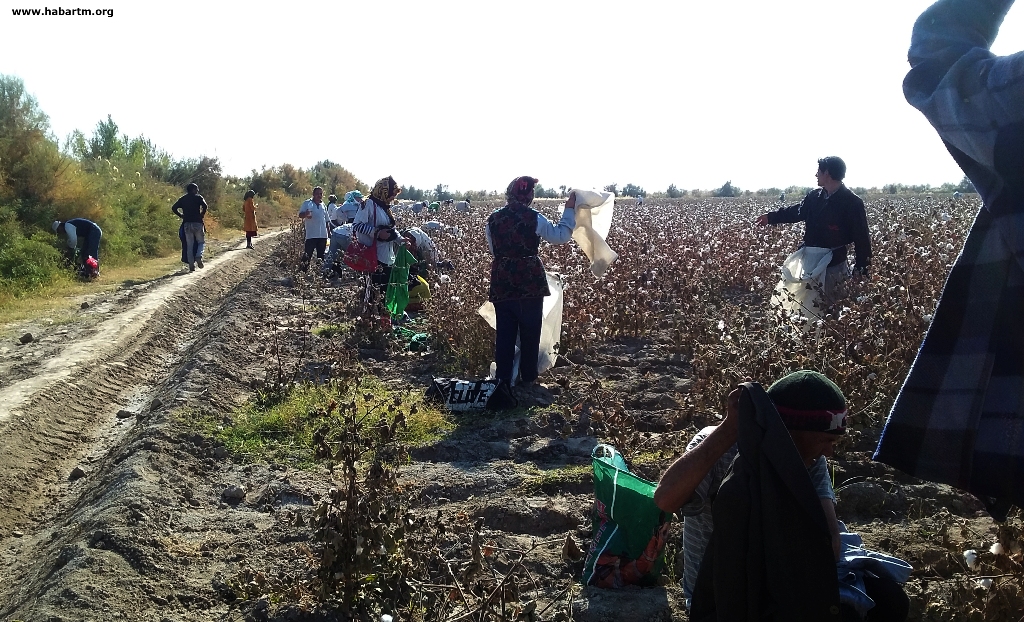
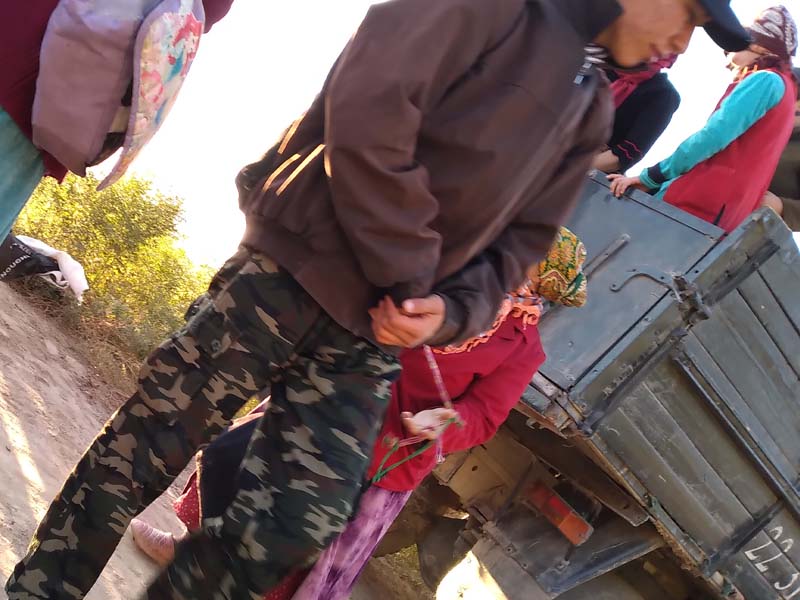
The work of picking cotton itself takes on particularly brutal forms. Workers are transported 30 to 50 kilometers over rough, unpaved roads in old flatbed trucks. The vehicles frequently break down. The trucks are privately owned and are hired by farmers or archins to transport pickers for 200 to 300 manats.
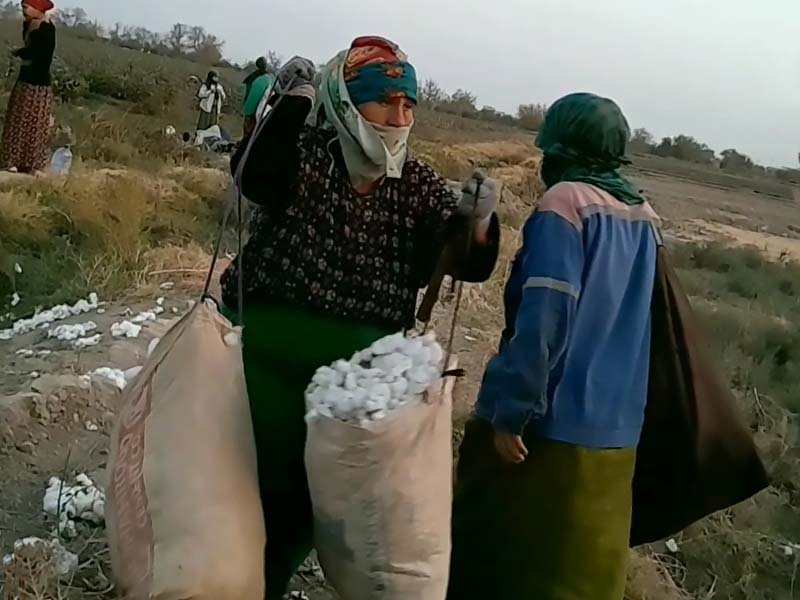
Pickers must bring their own food, water and aprons.
For fields far from populated areas, institutions such as kindergartens and gas and electricity utilities prefer to hire local pickers. Otherwise, their employees would not meet their picking quotas because they would arrive too late.
Hired pickers receive 20 to 30 manats a day ($1 to $1.50) from civil servants, as well as payment for the cotton they pick. Most farmers pay 0.8 manats per kilogram, while some pay 0.9 manats. Picking 50 kilograms a day would therefore bring in about 70 manats ($3.50). But in Ahal and Mary provinces, most pickers collect no more than 25 kilograms because there is little cotton in the fields.
Pickers receive payment from farmers only after the farmers have delivered their own harvest and been paid for it.
Most pickers are women.
Many hired pickers are children as young as 12. No one checks their age when they are recruited and sent to the cotton fields.
















Add comment
your e-mail will not be published